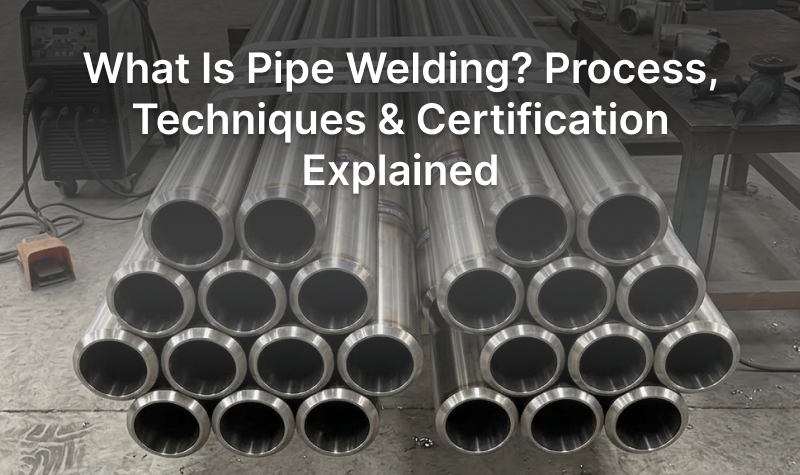
Pipe welding is a specialised welding practice used to join pipes and tubes that transport liquids, gases or semi-solids under controlled or high-pressure conditions. These welded joints must remain secure over long periods while handling internal pressure, temperature variations and external stress. As a result, pipe welding demands greater precision and discipline than general fabrication welding.
This type of welding is widely applied across oil and gas, power generation, chemical processing, construction, food-grade manufacturing and stainless steel fabrication industries. In each of these sectors, the integrity of a pipe weld directly affects operational safety and system efficiency.
What Is Pipe Welding?
Pipe welding refers to the permanent joining of pipes through fusion of the base material, often supported by filler metal. The objective is to create a continuous, leak-proof joint capable of handling service loads without failure.
Pipe welding is commonly used in:
- Industrial pipelines and refineries
- Thermal and nuclear power plants
- Chemical and pharmaceutical facilities
- Food and beverage processing units
- Stainless steel railings, furniture and equipment fabrication
- Structural and infrastructure projects
Pipe joints differ from flat welds in geometry and accessibility, making welding more technically demanding. Precision in alignment, penetration and heat control is essential for long-term performance.
Pipe Welding Process Explained
The pipe welding process follows a defined sequence to achieve consistent weld quality and joint strength. Each step plays a role in preventing defects and ensuring durability.
Pipe Preparation
Pipes are cut accurately and bevelled to allow proper weld penetration. The surfaces are cleaned to remove oil, moisture, rust or mill scale. Even minor contamination can lead to porosity or weak welds.
Fit-Up and Alignment
Correct alignment ensures a uniform root gap and smooth weld profile. Poor fit-up often results in a lack of penetration or internal defects, especially in pressure systems.
Tack Welding
Small tack welds secure the pipes in position. This prevents movement during welding and helps maintain consistent alignment throughout the process.
Root Pass
The root pass seals the joint internally. It must achieve full penetration without burn-through. TIG welding is commonly used for this stage in stainless steel applications.
Filler and Capping Passes
Additional passes build the weld thickness and complete the joint. The final cap pass also improves surface strength and appearance.
Inspection and Testing
Visual checks are followed by non-destructive testing when required. These inspections confirm weld soundness and compliance with applicable standards.
A disciplined pipe welding process reduces rework and improves joint reliability.
Common Pipe Welding Techniques
Different pipe welding techniques are selected based on material type, wall thickness, position and working conditions.
Shielded Metal Arc Welding (SMAW)
Also known as stick welding, SMAW is widely used for pipe welding due to its adaptability. It performs well outdoors and in confined spaces. This method is commonly used for carbon steel and stainless steel pipes.
Gas Tungsten Arc Welding (GTAW / TIG)
TIG welding delivers precise and clean welds. It is frequently used for root passes and for applications requiring hygienic welds, such as food-grade and pharmaceutical pipelines.
Gas Metal Arc Welding (GMAW / MIG)
MIG welding offers higher productivity in controlled environments. It is often used for filler and cap passes during shop fabrication.
Submerged Arc Welding (SAW)
SAW is suitable for thick-walled and large-diameter pipes. It provides deep penetration and high deposition rates, making it ideal for heavy industrial projects.
Orbital Welding
Orbital welding is an automated technique used in stainless steel piping systems requiring repeatability and precision. It is commonly applied in clean-room and high-purity installations.
Each technique requires appropriate consumables and operator expertise to deliver consistent results.
Pipe Welding Positions
Pipe welding positions influence difficulty and skill requirements.
- 1G Position – Pipe rotates while welding remains stationary
- 2G Position – Pipe is fixed vertically; welding is done horizontally
- 5G Position – Pipe is fixed horizontally; welding is done in multiple positions
- 6G Position – Pipe is fixed at a 45-degree angle and welded without rotation
The 6G position is considered the most demanding and is widely used for qualification testing.
Importance of Pipe Welding Certification
Pipe welding certification confirms that a welder can produce joints that meet defined technical and safety standards. Many industries mandate certified welders to maintain compliance and reduce operational risk.
Certified pipe welders demonstrate the ability to:
- Maintain consistent weld quality
- Minimise the risk of leaks and joint failure
- Work across fixed and complex welding positions
- Follow recognised welding procedures and codes
Certification tests are typically conducted as per standards such as ASME, ISO or AWS. These tests involve welding pipes in fixed positions under inspection conditions.
For fabrication companies and contractors, employing certified welders improves project reliability and lowers the likelihood of rework or rejection.
Materials Used in Pipe Welding
Pipe welding is performed on a range of materials, each requiring compatible techniques and consumables.
- Carbon steel
- Stainless steel
- Alloy steel
- Duplex and super duplex stainless steel
- Aluminium and nickel-based alloys
Stainless steel pipe welding demands controlled heat input and suitable filler materials to preserve corrosion resistance and mechanical strength.
Role of Quality Consumables in Pipe Welding
The quality of a pipe weld depends not only on technique but also on the performance of welding consumables. Electrodes, filler wires and accessories directly influence arc stability, bead shape and joint strength.
Using consistent consumables helps fabricators maintain uniform weld quality across multiple projects. This is particularly important in stainless steel pipe welding, where material compatibility and controlled deposition are essential.
Superon supports pipe welding applications with a complete range of stainless steel welding electrodes, MIG and TIG filler wires and welding accessories designed for consistent performance. As a one-stop solution provider, Superon enables fabricators and contractors to source dependable consumables from a single partner, reducing variability and simplifying procurement across fabrication needs.
Conclusion
Pipe welding remains a critical operation in industries where system integrity and safety cannot be compromised. A well-defined pipe welding process, suitable pipe welding techniques and certified welders form the foundation of reliable joints.
From material preparation to inspection, every stage contributes to long-term performance. When supported by quality consumables and disciplined execution, pipe welding delivers joints capable of meeting demanding service conditions across industrial and fabrication environments.