
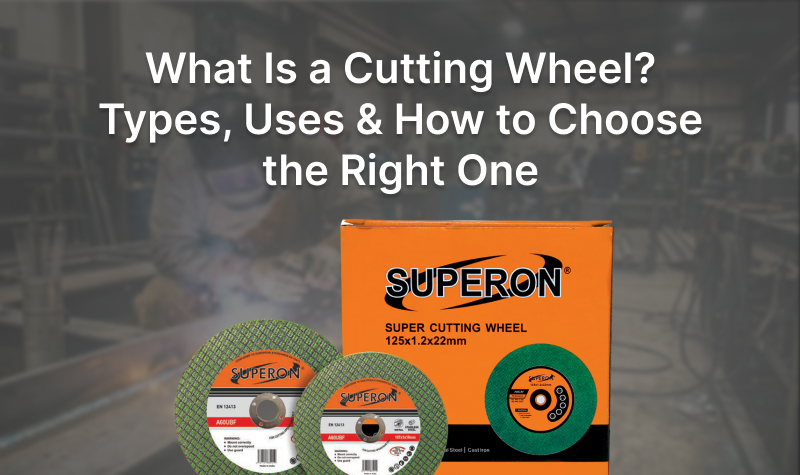
Cutting wheels are fundamental consumables in metal fabrication and industrial maintenance. They are used at the earliest stage of material processing, where accuracy, edge quality and dimensional control are established. The performance of a cutting wheel influences fit-up, welding consistency and overall fabrication efficiency.
Knowing how cutting wheels function, the different types of cutting wheels available, their practical uses and the factors involved in selection helps fabricators maintain stable and repeatable outcomes across workshop and site operations.
What Is a Cutting Wheel?
A cutting wheel is a bonded abrasive disc designed to cut metal and other rigid materials through abrasion. Unlike saw blades, it does not use teeth to remove material. Material removal occurs as abrasive grains on the wheel surface fracture the workpiece at high rotational speeds, producing a narrow and controlled cut.
A typical cutting wheel consists of abrasive grains, bonding materials and fibreglass reinforcement layers. The abrasives perform the cutting action, the bond holds them together under load and the reinforcement ensures structural stability at operating speeds. As the wheel wears during use, fresh abrasive grains are exposed, allowing consistent cutting until the disc is consumed.
How Cutting Wheels Work in Fabrication Environments?
In fabrication environments, cutting wheels operate under controlled but variable conditions depending on material type, section thickness and machine capability.
Their performance is influenced by the following factors:
- High rotational speed that enables abrasive grains to fracture the material surface
- Progressive and uniform wear that exposes fresh abrasive during cutting
- Formation of a narrow kerf that limits material loss and heat input
- Dependence on steady feed pressure rather than excessive operator force
Excessive pressure increases heat generation, accelerates disc wear and can distort thin sections, particularly in stainless steel fabrication.
Types of Cutting Wheels Based on Material
Different base materials respond differently to abrasive cutting. Selecting a cutting wheel designed for the specific material supports clean cuts and protects surface integrity.
Cutting Wheels for Mild Steel and Carbon Steel
These are general-purpose cutting wheels, typically made with aluminium oxide abrasives. They are widely used for cutting structural steel sections, plates, pipes and bars in fabrication and maintenance work. They offer balanced cutting speed and durability for everyday workshop and site applications.
Cutting Wheels for Stainless Steel
Stainless steel cutting wheels are formulated to prevent contamination. They are free from iron, sulphur and chlorine, which can otherwise cause corrosion at the cut edge. They are used in the fabrication of railings, furniture, kitchen equipment and process equipment, where controlled cuts reduce the need for extensive edge preparation before welding.
Cutting Wheels for Aluminium and Non-Ferrous Metals
Non-ferrous metals such as aluminium, copper and brass tend to clog standard abrasives. Cutting wheels for these materials are designed to minimise loading and smearing. Using the correct wheel supports consistent cutting performance and reduces disc glazing during repeated operations.
Cutting Wheels for Stone and Masonry
Stone and masonry cutting wheels use silicon carbide abrasives and are intended only for non-metallic materials such as concrete, tiles and stone slabs. These wheels should not be used on metal, as performance and wheel integrity are compromised.
Cutting Wheel Thickness and Its Effect on Cutting Performance
Wheel thickness influences cutting speed, edge quality and heat input. Thinner cutting wheels are commonly used where precision and clean edges are required. They cut faster, remove less material and generate lower heat, making them suitable for stainless steel and sheet metal work. Thicker wheels offer increased rigidity and are preferred for heavy sections or demanding site conditions where stability is prioritised. Thickness selection should consider section size, required accuracy and operator control.
Common Uses of Cutting Wheels
Cutting wheels are used across multiple stages of fabrication and installation.
Typical applications include:
- Cutting pipes, tubes and hollow sections to length
- Trimming plates, flats and angles
- Removing damaged or incorrect weld sections
- On-site modification and fitment during erection
Accurate cutting at this stage improves alignment and supports consistent welding outcomes.
How to Choose the Right Cutting Wheel?
Selecting the correct cutting wheel involves evaluating practical variables related to material, equipment and application conditions.
Base Material
- Mild steel and carbon steel require general-purpose aluminium oxide wheels
- Stainless steel requires contamination-free cutting wheels
- Aluminium and non-ferrous metals require clog-resistant formulations
- Stone and masonry require silicon carbide wheels designed only for non-metallic materials
Wheel Thickness
- Thin wheels support faster cutting and cleaner edges
- Medium-thickness wheels balance speed and stability
- Thicker wheels provide rigidity for heavy sections and site work
Machine Compatibility
- The wheel diameter must match the grinder or cutting machine specification
- The maximum RPM rating of the wheel must exceed the machine’s no-load speed
- Incorrect size or speed rating increases the risk of failure and inconsistent cutting
Application Environment
- Workshop fabrication requires consistent cutting behaviour across operators
- Site work demands durability under variable conditions
- Repetitive production benefits from predictable wheel wear and performance
Common Cutting Wheel Selection and Usage Errors
Several performance issues arise from incorrect selection or handling.
Common errors include:
- Using a single cutting wheel type across different materials
- Applying side pressure during cutting
- Forcing the wheel instead of allowing a steady feed
- Continuing to use worn or damaged wheels
Avoiding these practices supports better cut accuracy, wheel life and downstream fabrication quality.
Cutting Wheels and Fabrication Process Reliability
Cutting is the first physical operation in most fabrication workflows. Variability at this stage affects alignment, joint preparation and welding parameters.
Reliable cutting wheels contribute to:
- Consistent edge geometry and fit-up
- Reduced need for secondary edge preparation
- Stable heat input during welding
- Predictable fabrication outcomes
At Superon Technik, fabrication reliability is addressed through consumable consistency. By maintaining uniform abrasive composition and dimensional accuracy in cutting wheels, stable cutting performance is supported across workshop and site environments, allowing smoother integration with welding and assembly processes.
Conclusion
A cutting wheel is a critical fabrication consumable whose type, thickness and material compatibility directly influence cutting accuracy and downstream process quality. Proper selection and application of cutting wheels enable consistent results across fabrication tasks, supporting reliable production in both workshop and site conditions.