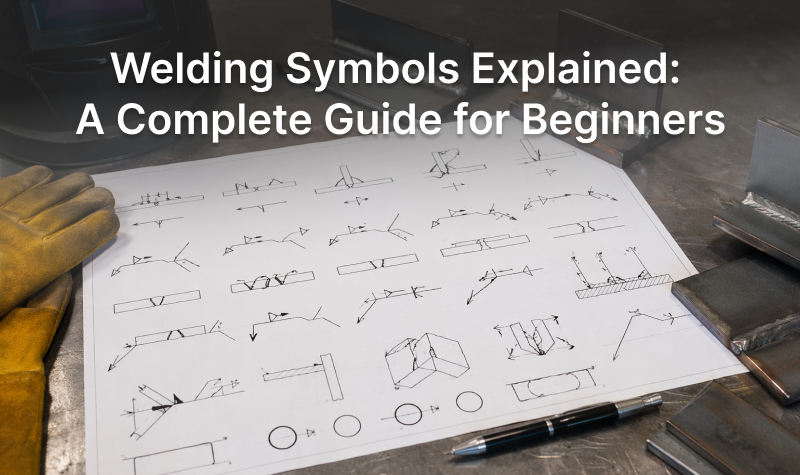
Welding drawings use symbols instead of long instructions to show how joints must be made. These symbols act as a shared technical language between designers, engineers, supervisors and welders. When read correctly, a single welding symbol can convey details about joint type, weld size, location and finishing requirements.
For beginners, welding symbols may appear confusing at first glance. With a clear breakdown and regular exposure, they become practical tools that guide daily fabrication work.
What Is a Welding Symbol?
A welding symbol is a standardised graphic mark placed on engineering drawings to specify welding requirements. Instead of describing each weld in text, symbols provide precise, repeatable instructions that remain consistent across workshops and job sites.
These symbols help ensure that every welder follows the same specification, regardless of location or project size. In stainless steel fabrication, where appearance and joint quality are equally important, welding symbols play a critical role.
Why Are Welding Symbols Important?
Fabrication errors often begin with misread drawings. Incorrect weld placement or size can weaken structures, increase costs and delay production schedules.
Welding symbols help avoid these issues by:
- Providing clear instructions without lengthy explanations
- Reducing miscommunication between design and fabrication teams
- Maintaining uniform weld quality across batches
- Saving time during fabrication and inspection
- Supporting compliance with industry and safety standards
For workshops handling multiple projects at once, the correct interpretation of basic welding symbols supports a smoother workflow and fewer corrections.
Main Parts of a Welding Symbol
Every welding symbol follows a standard layout. Learning its components makes reading drawings far simpler.
Reference Line
The reference line is the horizontal line that holds all welding information. Every weld symbol is placed in relation to this line.
Arrow
The arrow points to the joint or location where welding is required. Its direction is critical, especially when only one side of the joint needs to be welded.
Weld Symbol
The weld symbol indicates the type of weld to be made. Its position above or below the reference line shows which side of the joint requires welding.
Tail
The tail is optional. When included, it usually specifies the welding process, standard or additional notes needed to complete the job.
Arrow Side and Other Side Welds
One of the most important rules in welding symbols relates to symbol placement.
- A symbol placed below the reference line means welding is required on the arrow side
- A symbol placed above the reference line indicates welding on the opposite side
- Symbols on both sides mean the joint must be welded on both faces
This positioning removes guesswork and ensures welds are applied exactly where required.
Basic Welding Symbols Used in Fabrication
The basic welding symbols appear repeatedly on fabrication drawings. These form the foundation of welding symbol knowledge.
Fillet Weld Symbol
The fillet weld symbol is shaped like a triangle. It is widely used for T-joints, lap joints and corner joints, especially in structural and stainless steel fabrication.
Groove Weld Symbols
Groove welds join metal pieces edge to edge. Each groove type has its own symbol:
- Square groove
- V-groove
- Bevel groove
- U-groove
- J-groove
These symbols also indicate edge preparation, which affects weld penetration and strength.
Plug and Slot Weld Symbols
Plug and slot weld symbols are used when holes or elongated slots are filled with weld metal to join overlapping components.
Spot and Seam Weld Symbols
These symbols are mainly used in sheet metal and resistance welding applications, common in light fabrication and enclosures.
Weld Size and Measurement Details
Welding symbols include numerical values that specify weld size. These figures appear next to the weld symbol on the reference line.
- Fillet weld sizes usually refer to leg length
- Groove weld sizes may specify depth, root opening or groove angle
Correct weld size ensures joints meet load requirements without unnecessary heat input or material usage.
Weld Length and Intermittent Welding
Not every joint needs to be welded continuously. Welding symbols clearly indicate when intermittent welding is allowed.
- Weld length shows how long each weld section should be
- Pitch indicates the spacing between weld sections
- Continuous welds appear without spacing information
Intermittent welds are often used to reduce distortion and save time without compromising strength.
Contour and Finish Symbols
Some joints require a specific surface profile after welding. Contour symbols communicate this requirement.
Common contour options include:
- Flat
- Convex
- Concave
Finish symbols may specify grinding, machining or other methods. This is especially important for visible stainless steel applications such as railings, furniture and kitchen equipment.
Welding Symbols in Stainless Steel Fabrication
Stainless steel fabrication demands precision, clean weld profiles and controlled heat input. Welding symbols guide joint preparation, weld placement and finishing requirements, helping fabricators achieve consistent results.
Using reliable consumables also supports the accurate execution of drawing instructions. Superon supports fabricators across India with stainless steel welding electrodes, MIG and TIG filler wires, brazing alloys and accessories. Consistent quality consumables help welders translate drawing specifications into durable, visually clean joints.
Common Errors Made by Beginners
New welders and fabricators often struggle with:
- Confusing the arrow side and the opposite side placement
- Ignoring weld size values
- Overlooking tail instructions
- Mixing up similar groove symbols
Regular exposure to drawings and shop-floor discussions helps reduce these mistakes over time.
How to Build Confidence with Welding Symbols?
Practical exposure remains the best learning method.
- Review fabrication drawings daily
- Match symbols with completed welds on the shop floor
- Refer to standard charts during inspection
- Discuss drawings with experienced supervisors
With repetition, welding symbols become familiar references rather than obstacles.
Conclusion
Welding symbols are an essential part of fabrication communication. They replace lengthy instructions with precise visual guidance that ensures accuracy, consistency and quality. For beginners, learning welding symbol basics builds confidence and improves workmanship from the earliest stages of training.
Whether working on stainless steel railings, gates, furniture or industrial components, the correct use of basic welding symbols supports stronger joints, cleaner finishes and efficient fabrication. Combined with quality consumables and sound technique, welding symbols help fabricators deliver results that meet both structural and visual expectations.