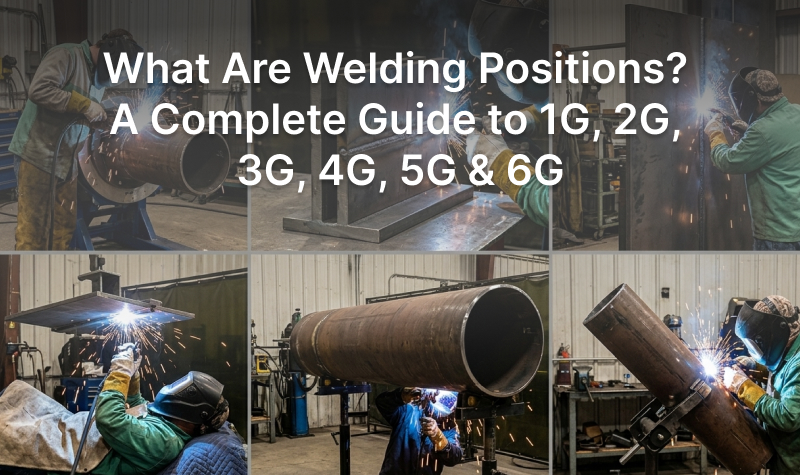
Welding positions define the orientation of the joint in relation to the welder and the direction of gravity. They influence weld penetration, bead shape, heat control and overall joint integrity. In fabrication work, welding positions are not selected at random. They are determined by job conditions, material type, joint design and whether the component can be rotated during welding.
Across fabrication shops, construction sites and industrial installations, standard welding positions help maintain consistency in training, inspection and qualification testing. These positions are commonly identified using the letter G for groove welds. Understanding how each welding position works is essential for welders, supervisors and fabricators involved in structural, pipe and stainless steel fabrication.
What Are Welding Positions?
Welding positions describe how a workpiece is placed during welding and how the weld is executed in relation to gravity. Gravity affects the behaviour of molten metal, slag flow and arc stability. As welding moves from flat to vertical or overhead positions, controlling the weld pool becomes more demanding.
Standardised welding positions allow fabricators to specify skill requirements clearly and ensure that welders are qualified for the type of work assigned. The most recognised groove welding positions are 1G, 2G, 3G, 4G, 5G and 6G.
Importance of Welding Positions in Fabrication
Welding positions have a direct impact on weld quality and productivity. Poor position control can lead to defects such as a lack of fusion, excessive spatter, slag inclusion and uneven penetration.
From a project standpoint, welding positions also determine:
- Welder qualification levels
- Inspection criteria
- Welding procedure specifications
- Time and cost of fabrication
Certain positions are easier to perform in a workshop environment, while others are unavoidable during site installation or repair work.
1G Welding Position (Flat Position)
The 1G welding position is performed with the workpiece placed horizontally, allowing welding on the top side of the joint. This position offers maximum control over the weld pool since gravity supports metal deposition.
Key features of the 1G welding position include:
- Stable weld pool control
- Consistent penetration
- Lower skill requirement compared to other positions
The 1G position is commonly used for plate fabrication, pipe sections in workshops and stainless steel components that can be rotated or positioned freely.
2G Welding Position (Horizontal Position)
In the 2G welding position, the workpiece remains vertical while the weld is deposited horizontally. Gravity pulls molten metal downward, requiring careful manipulation of the electrode or torch.
This position is often used for:
- Vertical plates and frames
- Pressure vessel shells
- Structural steel joints
Maintaining uniform bead shape in the 2G welding position requires balanced heat input and controlled travel speed.
3G Welding Position (Vertical Position)
The 3G welding position involves welding along a vertical axis. Welding may be performed either upward or downward, depending on material thickness and procedure requirements.
Vertical welding introduces challenges such as metal sagging and uneven penetration if heat input is not properly controlled. Vertical-up welding is preferred for thicker materials due to better penetration, while vertical-down welding is faster and used for thinner sections.
Applications of the 3G welding position include:
- Structural columns
- Frames and supports
- Stainless steel fabrication where repositioning is limited
4G Welding Position (Overhead Position)
The 4G welding position requires welding from beneath the joint. Gravity works against the weld pool, making overhead welding one of the most demanding positions.
Key considerations for 4G welding include:
- Controlled electrode angles
- Reduced heat input to prevent sagging
- Strict safety measures
Overhead welding is commonly encountered during equipment maintenance, site fabrication and repair work where components cannot be dismantled or rotated.
5G Welding Position (Fixed Pipe Position)
The 5G welding position is specific to pipe welding. The pipe is fixed horizontally and cannot be rotated during welding. The welder must complete the joint by welding through flat, vertical and overhead sections in sequence.
This position is widely used in:
- Pipeline fabrication
- Process piping systems
- Industrial installations
The 5G welding position demands strong control over arc length, travel speed and weld pool behaviour across multiple orientations within the same joint.
6G Welding Position (Inclined Fixed Pipe Position)
The 6G welding position places the pipe at a fixed angle, usually 45 degrees. Welding must be carried out around the entire circumference without moving the pipe.
This position combines all welding orientations and requires advanced skill, coordination and endurance. Due to its complexity, the 6G welding position is often used as a benchmark for high-level welder qualification.
Typical applications include:
- High-pressure piping
- Critical industrial systems
- Complex stainless steel pipe assemblies
A welder qualified in the 6G position is generally considered capable of handling most other welding positions.
Welding Positions and Consumables Selection
Different welding positions place different demands on consumables. Factors such as slag control, arc stability and penetration characteristics become increasingly important in vertical, overhead and fixed positions.
Electrode coatings, filler wire chemistry and flux behaviour must support smooth metal transfer and consistent bead formation. In stainless steel fabrication, reliable consumables help maintain corrosion resistance and weld appearance across all positions.
As a one-stop solution for stainless steel fabrication needs, Superon offers welding electrodes, filler wires and accessories designed to perform consistently across varied welding positions commonly encountered in fabrication work.
Welding Positions and Skill Progression
Welders typically begin their training with flat and horizontal positions before progressing to vertical, overhead and fixed pipe welding. Each position develops a different set of skills related to heat control, body positioning and weld pool management.
For fabricators, assigning work based on welding position capability helps reduce rejection rates and ensures compliance with project specifications. For welders, mastering multiple positions increases versatility and long-term career value.
Conclusion
Welding positions form the foundation of practical welding work. From the straightforward 1G welding position to the highly demanding 6G welding position, each orientation presents unique challenges that influence weld quality and execution.
A clear understanding of welding positions helps fabricators plan jobs effectively, select appropriate procedures and maintain consistent quality standards. For welders, proficiency across positions strengthens technical capability and supports reliable fabrication outcomes across workshop and site conditions.