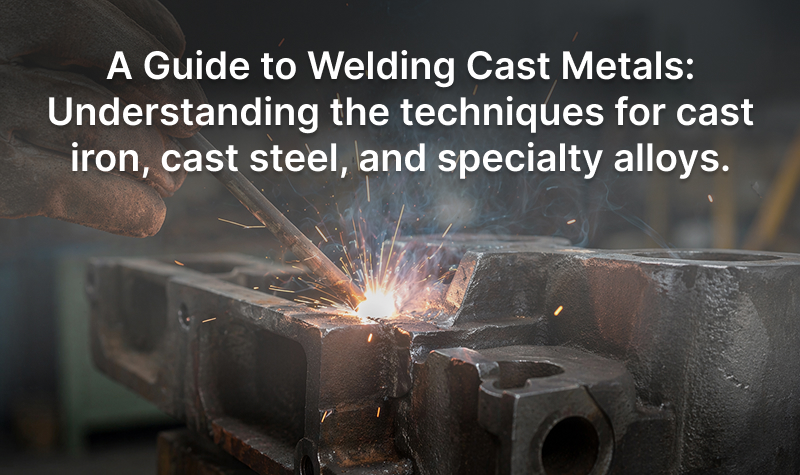
Welding cast materials plays an essential role in fabrication, repair and maintenance across many industries. Cast components are widely used because they can be produced in complex shapes and thick sections, making them suitable for demanding industrial environments. However, welding them requires careful planning due to high carbon content, brittleness and sensitivity to heat. Understanding how to weld Cast Iron and the differences in Cast Iron vs Cast Steel helps fabricators choose suitable welding consumables and techniques for dependable and consistent results.
What Are Welding Cast Materials?
Cast metals are made by melting metal, pouring it into a mould, and letting it cool into shape. They are different from metals that are rolled or hammered into shape. This difference in how they are made gives them a different internal structure, which can affect how easily they can be welded.
- Higher carbon content
- Possibility of porosity or inclusions
- Greater brittleness compared to wrought metals
These characteristics make it essential to use careful preparation, controlled heat input, and suitable filler materials when welding cast metals. Industries such as automotive, construction, power generation, fabrication workshops and heavy machinery rely on welding cast components to maintain and extend the life of the equipment.
Difference Between Cast Iron, Steel & Alloys
Understanding material differences before welding helps in selecting the right process, heat control method and filler material.
| Property | Cast Iron | Cast Steel | Cast Alloys |
| Carbon Content | High (2–4%) | Low (<2%) | Varies |
| Weldability | Difficult | Moderate to good | Depends on composition |
| Strength & Ductility | Brittle, low ductility | Higher ductility | Tailored properties |
| Heat Sensitivity | High cracking risk | Better heat tolerance | Varies |
| Typical Use | Machinery bases, pipes | Structural parts | Aerospace/auto components |
Material composition directly influences welding procedures and preparation techniques.
Applications of Cast Iron, Steel & Alloys
Cast metals are widely used in applications where strength, durability and complex shapes are required.
| Material | Common Applications |
| Cast Iron | Engine blocks, machine beds, pumps, pipes |
| Cast Steel | Construction components, valves, gears |
| Cast Alloys | Automotive parts, aerospace components, turbine parts |
These applications highlight the importance of reliable welding practices to maintain performance and service life.
Techniques Used for Welding Cast Iron, Steel & Alloys
Welding cast materials requires controlled heat input, suitable filler selection and proper cooling methods to reduce cracking risks and ensure reliable joints.
Welding Cast Iron
Understanding how to weld Cast Iron begins with careful heat management and preparation. Key practices include:
- Preheating to reduce thermal shock and minimise cracking risk
- Using low heat input and short weld passes
- Controlling cooling to prevent residual stress
Stick and TIG welding processes are commonly used depending on the repair or fabrication requirement.
Welding Cast Steel
Cast Steel offers better weldability but still requires controlled procedures. Important considerations:
- Moderate preheating for thick sections
- Multi-pass welding for strong joints
- Selection of compatible filler materials
MIG, TIG and Stick welding processes can be used depending on job conditions.
Welding Cast Alloys
Speciality Cast Alloys require precise control and understanding of material composition. Key considerations include:
- Identifying alloy composition before welding
- Using appropriate shielding gases
- Selecting specialised filler metals
These steps help maintain mechanical properties and corrosion resistance.
Common Welding Challenges and How to Overcome Them
Cast materials present unique challenges due to their structure and carbon content, making preparation and process control essential.
Cracking
- Challenge: Thermal stress and carbon content may cause cracking.
- Prevention: Proper preheating and controlled cooling.
Porosity
- Challenge: Trapped gases or contaminants may create pores.
- Prevention: Thorough cleaning and proper shielding.
Distortion
- Challenge: Uneven heating can lead to dimensional changes.
- Prevention: Balanced welding sequence and heat control.
Residual Stresses
- Challenge: Rapid cooling may introduce internal stress.
- Prevention: Controlled cooling and post-weld heat treatment when required.
Best Welding Processes for Cast Metals
Different welding processes offer varying levels of heat control, penetration and repair suitability depending on the cast material and application.
- Stick Welding (SMAW): Stick welding is widely used for repair and on-site work due to its reliability and flexibility. It performs well in outdoor conditions and is suitable for welding cast iron and cast steel sections.
- MIG Welding (GMAW): MIG welding offers higher productivity in workshop environments and supports faster fabrication processes. It is commonly used for cast steel components where consistent weld quality and efficient metal deposition are required.
- TIG Welding (GTAW): TIG welding provides excellent heat control and precision, making it suitable for thinner sections and detailed welding applications. It helps produce clean, high-quality welds with minimal spatter and distortion.
- Oxy-Acetylene Brazing: Oxy-acetylene brazing is useful for repair applications, especially when lower heat input is required. It reduces cracking risk in cast iron components and helps restore damaged parts effectively.
Selecting the correct welding process depends on material type, thickness and working environment. Choosing reliable abrasives and welding solutions from Superon Technik helps ensure consistent performance and dependable results in demanding fabrication tasks.
Essential Preparation Before Welding Cast Metals
Proper preparation is essential for producing strong, reliable, and defect-free welds on cast components.
- Cleaning and Inspection: Remove oil, grease, rust and coatings to improve weld quality.
- Preheating Guidelines: Preheating reduces thermal stress and improves fusion.
- Joint Preparation: Proper groove design supports better penetration and strength.
- Choosing Suitable Filler Materials: Selecting compatible filler materials supports consistent weld performance.
Safety Tips for Welding Cast Metals
Working with cast metals involves high heat, fumes and heavy components, so following proper safety practices is essential to maintain a safe and efficient workspace
- Use PPE: Wear a welding helmet, heat-resistant gloves, protective clothing and safety footwear to protect against sparks, heat and molten metal.
- Ensure Ventilation: Maintain proper airflow or use fume extraction systems to reduce exposure to welding fumes and gases.
- Control Heat Safely: Preheating and slow cooling should be managed carefully to avoid burns and accidental contact with hot surfaces.
- Handle Components Carefully: Use lifting equipment and stable positioning to safely manage heavy cast parts during welding.
Conclusion
Welding cast metals requires proper preparation, controlled heat input and suitable welding consumables. Understanding the differences between Cast Iron, Cast Steel and speciality alloys helps fabricators achieve reliable and consistent results. With the right approach and quality welding solutions, professionals can improve productivity, maintain weld integrity and support long-term performance across fabrication, repair and maintenance applications.