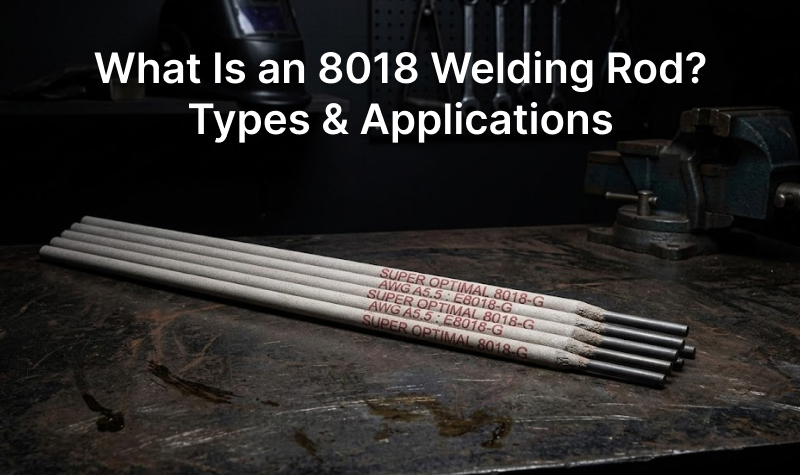
Welding electrodes are identified by a number code that tells welders about their strength, coating and applications. Among the many electrodes used in fabrication, the 8018 Welding Rod is known for producing strong and reliable welds.
This electrode is widely used in heavy fabrication, structural steel work and industrial construction because it delivers high-strength weld deposits with excellent resistance to cracking. Understanding its specifications and applications helps welders choose the right rod for demanding welding jobs.
What is an 8018 Welding Rod?
An 8018 Welding Rod is a low-hydrogen electrode used in shielded metal arc welding (SMAW). It is designed to create strong weld joints in high-strength steel structures.
The number 8018 provides specific information about the electrode.
- 80 represents the tensile strength of the weld metal, which is 80,000 psi
- 1 indicates the electrode can be used in all welding positions
- 8 refers to a low hydrogen coating that works with AC and DC current
Because of this combination, the electrode is suitable for welding structures that must handle heavy loads and stress.
8018 Welding Rod Specifications
Understanding the 8018 Welding Rod specifications helps fabricators select the right electrode for their welding projects.
Tensile Strength
The weld metal produced by this electrode offers a tensile strength of around 80,000 psi. This makes it suitable for structural applications where strong joints are required.
Low Hydrogen Coating
The flux coating is designed to keep hydrogen levels very low. This reduces the risk of hydrogen-induced cracking, which can occur in thick steel or high-strength materials.
Welding Positions
The electrode can be used in flat, horizontal, vertical and overhead positions. This flexibility allows welders to use it in complex fabrication work.
Current Compatibility
8018 rods typically operate with AC or DC positive current. This allows them to work with different welding power sources.
Slag Formation
The coating forms a protective slag layer during welding. This slag protects the weld pool and helps produce a smooth weld bead.
Available Diameters
Common diameters include:
- 2.5 mm
- 3.15 mm
- 4.0 mm
- 5.0 mm
The choice depends on material thickness and welding current.
Key Characteristics of an 8018 Welding Rod
The 8018 Welding Rod is preferred in many fabrication industries because of its performance and reliability.
High Strength Welds
The electrode produces weld metal with excellent mechanical strength. This allows welded structures to handle heavy loads.
Reduced Risk of Cracking
Low hydrogen electrodes help prevent weld cracking, which is common in thick steel sections.
Smooth Weld Appearance
8018 rods produce neat weld beads with minimal spatter. This reduces the need for extra finishing work.
Good Penetration
The electrode offers good fusion between the weld metal and the base metal. This improves joint strength and durability.
Consistent Welding Performance
When used correctly, the rod produces reliable results across different welding positions.
Superon Technik produces high quality welding consumables designed to deliver consistent arc stability and reliable weld strength in demanding fabrication environments.
Types of 8018 Welding Rods
Various 8018 electrode variants are available, depending on alloy composition and specific industrial needs.
E8018
This is the standard electrode used in structural welding and heavy fabrication.
E8018-C3
This variation contains nickel, which improves toughness in low-temperature environments.
E8018-B2
These rods include chromium and molybdenum. They are used for welding heat-resistant steels.
E8018-G
This classification covers specialised alloy electrodes whose chemical composition may vary by manufacturer.
Each type is designed for specific welding conditions and materials.
8018 Welding Rod Uses
The 8018 Welding Rod uses cover several industries because of its high strength and durability.
Structural Steel Fabrication
Steel frameworks used in buildings, bridges and towers often require high-strength welds. The electrode helps create joints that can carry heavy loads.
Pressure Vessel Manufacturing
Pressure vessels operate under high internal pressure. Low-hydrogen electrodes like 8018 help prevent cracks in welded joints.
Heavy Machinery
Mining equipment, construction machines and industrial frames require strong weld joints. 8018 rods are commonly used in their fabrication.
Pipeline Construction
The electrode is also used in pipeline projects where thick steel sections must be welded securely.
Shipbuilding
Marine structures face constant vibration and stress. The strength of 8018 weld metal helps ensure long-term durability.
Fabricators often prefer reliable welding consumables from Superon Technik, which supplies consistent welding electrodes designed for demanding industrial welding applications.
What Is 8018 Welding Rod Used For
Understanding what the 8018 Welding Rod is used for becomes clearer when looking at practical welding scenarios.
Bridge Construction
Steel bridges require strong structural joints that can withstand traffic loads and environmental stress. High-strength electrodes like 8018 are commonly used in such structures.
Industrial Plant Fabrication
Factories, refineries and power plants use complex steel frameworks. Welders rely on strong electrodes to ensure structural stability.
Crane Manufacturing
Cranes handle extremely heavy loads. Weld joints must be strong enough to handle repeated lifting cycles.
Storage Tank Construction
Large storage tanks for oil and chemicals require crack-resistant welds. Low-hydrogen electrodes are often chosen for these applications.
These examples highlight why the electrode is widely used in high-strength steel fabrication.
Best Practices for Using 8018 Welding Rods
Following correct welding practices helps achieve the best results.
Store Electrodes Properly
Low-hydrogen rods should be stored in dry conditions or electrode ovens to prevent moisture absorption.
Clean the Metal Surface
Removing rust, oil and paint helps ensure proper weld penetration and strong joints.
Use Proper Amperage
Each electrode diameter has a recommended current range. Using the correct setting prevents coating damage.
Maintain a Short Arc
A short arc length improves weld control and reduces spatter.
Conclusion
The 8018 Welding Rod is widely used in structural welding because it produces strong, reliable weld joints. Its 80,000 psi tensile strength, low hydrogen coating and all-position usability make it suitable for demanding fabrication work.
From bridges and industrial plants to heavy machinery and pipelines, the electrode plays an important role in modern metal fabrication. Understanding 8018 Welding Rod specifications and 8018 Welding Rod uses helps welders choose the right electrode for strong and durable welds.