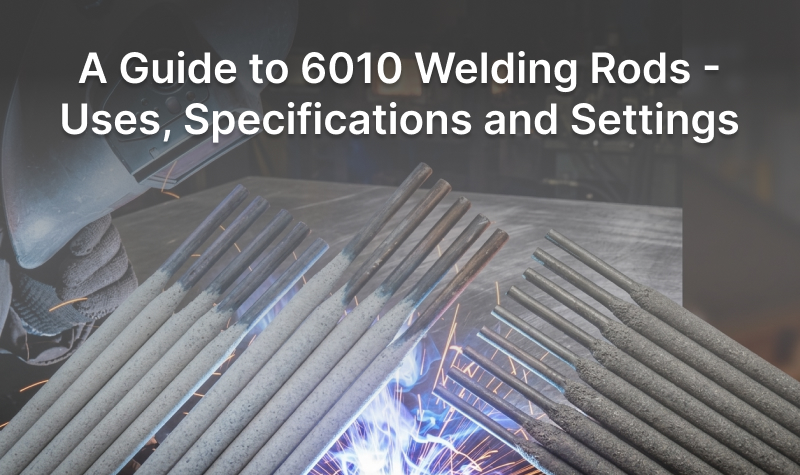
Choosing the right welding electrode is essential for achieving strong, reliable and high-quality welds. Among the available options, 6010 electrodes are widely known for their deep penetration and stable arc performance. If you are wondering what are 6010 welding rods used for, understanding their features and applications can help you make better welding decisions. These rods are commonly used in demanding conditions where strong root fusion and consistent performance are required, helping improve overall welding efficiency and results.
Understanding 6010 Welding Rods
6010 welding rods are classified under the American Welding Society (AWS) system as E6010 electrodes. Each part of the classification has a specific meaning that helps identify its properties and usage.
- E (Electrode): Indicates that the product is a welding electrode
- 60: Represents tensile strength of 60,000 psi
- 1: Suitable for all welding positions
- 0: Refers to the coating type and current characteristics
These electrodes are known for their fast-freezing behaviour, where the molten weld solidifies quickly, allowing better control in vertical and overhead positions. They are especially useful where strong penetration and precision are required. The strong arc force also helps cut through rust, oil and paint, making them ideal for repair and maintenance applications.
6010 Welding Rod Specifications and Key Features
6010 welding rods are designed for strong penetration and reliable performance in demanding welding conditions.
- Current Type: Operates on Direct Current Electrode Positive (DC+) only, ensuring stable arc performance and deep penetration capability for critical welding applications.
- Penetration: Provides deep penetration into the base metal, helping achieve strong root fusion and dependable joint strength in structural and repair work.
- Arc Type: Produces a forceful, concentrated arc that improves cutting action, allowing effective welding even on less-than-clean or unprepared surfaces.
- Flux Coating: Features a high cellulose sodium coating that supports fast-freeze characteristics and enhances overall arc stability during welding.
- Welding Positions: Suitable for all positions, including flat, horizontal, vertical and overhead welding, offering high versatility for field and workshop use.
- Slag Formation: Generates thin, easily removable slag that improves productivity and reduces post-weld cleaning time.
- Freezing Speed: Fast-freeze weld pool provides better control in challenging positions, especially vertical and overhead welding applications.
These features make 6010 electrodes suitable for repair, maintenance and structural welding where strength, penetration and reliability are critical.
What Are 6010 Welding Rods Used For
If you are asking what are 6010 welding rods used for, the answer lies in their ability to deliver deep penetration and strong welds even on difficult surfaces. Here are the most common 6010 welding rod uses:
- Pipeline Welding: 6010 rods are widely used for root pass welding in pipelines. Their deep penetration ensures strong joint fusion, which is critical in oil and gas pipelines.
- Structural Steel Fabrication: They are commonly used in construction projects where strength and durability are required. These rods help create solid welds in beams, frames and heavy structures.
- Shipbuilding and Repair: In shipyards, 6010 rods are used for welding and repairing metal parts exposed to harsh conditions. Their strong bonding ensures long-lasting performance.
- Repair and Maintenance Work: These rods perform well on dirty or rusted surfaces, making them ideal for repair jobs where cleaning is limited.
- Heavy Equipment Maintenance: Construction and mining equipment often requires strong welds. 6010 rods help maintain and repair such heavy-duty machinery.
Their versatility makes 6010 rods a preferred choice in industries where weld strength and reliability are more important than appearance.
Welding Techniques and Machine Settings
Using 6010 rods correctly requires proper technique and machine setup. Since these rods produce a strong arc, control is very important.
- Machine Settings: Use DC positive polarity with amperage set according to rod size. Maintain a stable current to ensure consistent arc performance and reduce fluctuations during welding operations for better control.
- Arc Control: Maintain a short arc length for deeper penetration. Use whipping or stitching motion to control heat and avoid holding the arc too long in one spot.
- Travel Speed: Keep a steady travel speed to ensure uniform weld beads. Adjust movement based on material thickness to prevent burn-through and achieve proper fusion.
- Joint Preparation: Clean the surface thoroughly by removing rust, paint and contaminants. Ensure proper fit-up to support strong fusion and reduce defects during welding.
6010 rods are not beginner-friendly. They require practice and skill to handle the aggressive arc. However, once mastered, they deliver excellent results in demanding welding tasks. Superon Technik provides electrodes that help maintain consistent arc performance, making it easier for welders to improve their technique over time.
Best Practices for Successful Welding with 6010 Rods
To get the best results from 6010 electrodes, it is important to follow a few simple practices:
- Proper Storage: Keep electrodes in a dry place to prevent moisture absorption. Moisture can affect weld quality and cause defects.
- Correct Electrode Angle: Maintain a slight drag angle for better control and penetration.
- Consistent Arc Length: A stable arc length ensures uniform weld quality and reduces spatter.
- Practice and Skill Development: Since 6010 rods are more difficult to use, regular practice helps improve control and weld appearance.
- Safety Measures: Always use proper protective equipment such as gloves, a helmet and safety glasses. Work in a well-ventilated area to avoid exposure to fumes.
Following these practices ensures better weld strength, fewer defects and improved overall performance.
Conclusion
6010 welding rods are widely used for applications that require deep penetration and strong, reliable welds. Understanding 6010 welding rod specifications and their practical uses helps in selecting the right electrode for different welding tasks. They are commonly used in pipelines, structural steel work and repair applications, where strong root fusion is essential. Knowing what are 6010 welding rods used for helps improve welding accuracy and efficiency. Although they require skill to handle, they deliver excellent results when used with proper technique and settings. With quality electrodes and correct practice, welders can achieve consistent, durable and high-strength welds across demanding applications.