In large-scale fabrication and industrial manufacturing, welding is not only about joining metals but about achieving consistency, strength and efficiency at scale. When projects involve thick materials, long weld seams and continuous production, conventional welding methods can become time-consuming and inconsistent. This is where Submerged Arc Welding becomes highly relevant. Known for its deep penetration and high deposition rates, this process is widely used in industries where weld quality and productivity are equally important. Understanding what SAW welding is, how it works and where it is best applied helps manufacturers make informed decisions for demanding welding operations.
What Is Submerged Arc Welding
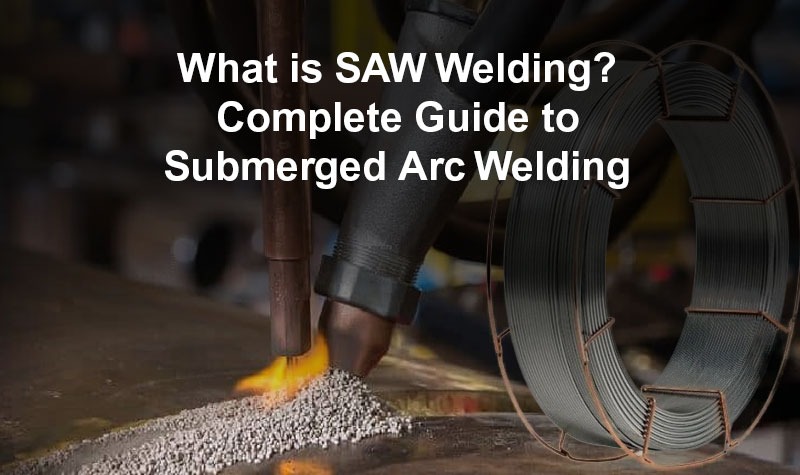
Submerged Arc Welding, commonly referred to as SAW welding, is a welding process in which the arc is formed beneath a layer of granular flux. The arc remains completely covered throughout the welding process, protecting it from atmospheric contamination. Unlike open-arc welding methods, the arc is not visible during operation.
In Submerged Arc Welding, a continuously fed consumable wire electrode creates the weld. The flux melts during welding, forming a protective slag layer over the weld bead. This results in clean welds with excellent mechanical properties and minimal spatter. The process is typically automated or semi-automated, making it ideal for long, straight welds and repetitive production work.
How SAW Welding Works
The SAW welding process begins by depositing a layer of flux over the joint to be welded. As electrical current passes through the wire electrode, an arc forms beneath the flux layer. The heat generated melts both the electrode and the base metal, creating a molten weld pool.
The flux plays a vital role in stabilising the arc and shielding the molten metal from oxygen and nitrogen. It also helps control the chemical composition of the weld. Once the weld cools, the slag solidifies on top and can be removed easily, leaving a smooth and uniform weld bead.
Because the arc is fully submerged, heat loss is reduced. This allows the use of higher current levels, leading to faster welding speeds and deeper penetration.
Key Characteristics of SAW Welding
Submerged Arc Welding is recognised for several distinctive characteristics that set it apart from other welding processes.
- High deposition rates that support faster production
- Deep weld penetration suitable for thick materials
- Stable arc performance resulting in uniform welds
- Minimal spatter and reduced fumes
- Excellent weld consistency over long seams
These features make SAW welding especially effective in controlled workshop environments where quality and repeatability are critical.
Materials Suitable for Submerged Arc Welding
SAW welding is primarily used for welding carbon steel, low-alloy steel and selected stainless steel grades. It performs best on thick plates and heavy sections where strong joint integrity is required.
Typical materials welded using Submerged Arc Welding include structural steel, pressure vessel steel and pipeline-grade steel. The process is not commonly used for thin materials, as the high heat input can cause distortion or burn-through.
Superon Technik provides SAW wires and fluxes designed to deliver stable arc performance, controlled weld chemistry and high deposition efficiency. These consumables support consistent results in demanding industrial applications.
Advantages of Submerged Arc Welding
Submerged Arc Welding offers several practical benefits that make it suitable for heavy-duty and high-volume welding applications.
- High welding speed and deposition rate, improving productivity
- Deep penetration, resulting in strong and durable weld joints
- Consistent weld quality with reduced risk of defects
- Minimal spatter and fumes, improving operator safety
- Lower labour requirements due to automation and semi-automation
These advantages make SAW welding a preferred choice for manufacturers focused on efficiency and long-term weld performance.
Limitations of SAW Welding
Despite its many strengths, SAW welding has certain limitations that must be considered.
The process is best suited for flat and horizontal welding positions and is not ideal for vertical or overhead work. Equipment mobility is limited, making it less suitable for on-site repairs or confined spaces. Precise joint preparation is also required to achieve proper fusion and penetration.
Understanding these limitations helps ensure that Submerged Arc Welding is applied only where it delivers the most value.
Applications of Submerged Arc Welding
Submerged Arc Welding is widely used in industries where long weld seams, thick materials and consistent quality are required.
- Shipbuilding and offshore structures
- Pressure vessels and storage tanks
- Pipelines and pipe manufacturing
- Structural steel fabrication for bridges and buildings
- Wind towers and heavy industrial machinery
In these applications, SAW welding supports high productivity while maintaining reliable and repeatable weld quality.
Importance of Consumables in SAW Welding
The performance of Submerged Arc Welding depends heavily on the quality of consumables used. The correct combination of wire electrode and flux influences arc stability, penetration, slag removal and mechanical properties of the weld.
Using high-quality consumables reduces the risk of weld defects such as porosity or slag inclusion. It also ensures consistent results across large production runs.
Superon Technik provides Submerged Arc Welding consumables engineered for low hydrogen levels, smooth slag detachability and uniform weld bead appearance. These features help maintain weld integrity and operational efficiency in critical industrial environments.
SAW Welding Compared to Other Welding Processes
When compared to welding methods such as MIG or Stick welding, Submerged Arc Welding offers superior productivity and consistency for large-scale fabrication. While other methods provide greater flexibility and portability, SAW welding excels in controlled environments with repetitive welding requirements.
Choosing between SAW welding and other processes depends on material thickness, production volume, welding position and workspace conditions. For heavy fabrication and long weld seams, Submerged Arc Welding remains one of the most efficient solutions available.
Conclusion
Submerged Arc Welding is a highly efficient and reliable welding process designed for industrial-scale applications. With its deep penetration, high deposition rates and consistent weld quality, SAW welding plays a crucial role in modern fabrication. While it is not suitable for every welding scenario, it delivers outstanding results when applied in the right environment. A clear understanding of Submerged Arc Welding, its benefits and its limitations helps manufacturers achieve stronger joints, improved productivity and dependable long-term performance.