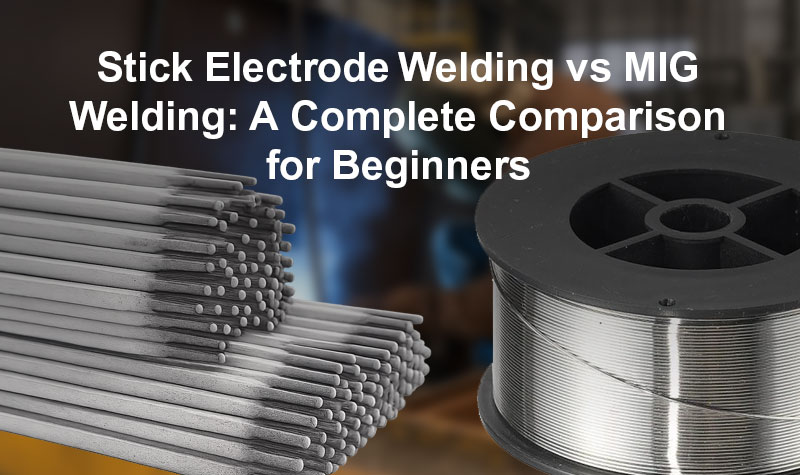
When you start learning welding, one of the first things you will notice is that there are many welding processes. Two of the most commonly used methods are stick welding and MIG welding. Both can create strong and reliable welds, but the way they work and the results they produce are very different. Understanding the MIG vs Arc welding comparison helps beginners choose the right method for their projects.
Arc welding usually refers to stick welding, while MIG welding is a wire-fed welding method. Superon supports both processes with dependable welding consumables designed for easy, smooth, and efficient welding.
What is Stick (Arc) Welding?
Stick welding, also known as Manual Metal Arc (MMA) or Shielded Metal Arc Welding (SMAW), uses stick welding electrodes, which are metal rods covered with flux, to create strong and durable welds. The rod works as both the electrode and filler material. When the rod touches the workpiece, an electric arc is created. This heat melts both the rod and the metal, forming a weld pool. The flux coating burns during welding and forms a shielding gas that protects the weld from contamination. The leftover flux becomes slag that must be removed after each weld.
Stick welding uses simple equipment and works well with AC or DC current. It is effective for outdoor conditions, dirty surfaces, and heavy-duty applications. This method is widely used in construction, pipeline work, repair jobs, and rural environments where portability and toughness are important.
Basics of MIG Welding
MIG welding, also known as Gas Metal Arc Welding (GMAW), uses a flexible wire electrode fed from a spool. When the trigger on the gun is pressed, the wire feeds out continuously. The electric current melts the wire and the base metal, forming a weld pool. Shielding gas such as argon or a mix of argon and carbon dioxide protects the weld from contamination.
MIG welding is known for being fast, clean, and easy to learn. The equipment typically allows users to adjust wire speed, voltage, and polarity. Because the wire feeds continuously, MIG welding is highly efficient for long welds with minimal interruption. It is widely used in automotive manufacturing, fabrication shops, industrial work, and general metalworking.
Difference Between MIG Welding and Arc Welding
Understanding the difference between MIG welding and Arc welding requires examining how each method behaves in real-world situations.
1. Weld Quality
MIG welding produces smooth, neat, and clean welds with little spatter. The weld beads look professional and require minimal cleaning. Stick welding creates strong welds but may produce more spatter and slag, which means extra cleaning. On thick metal, stick welding often produces deeper penetration, while MIG achieves cleaner results on thinner metals.
2. Indoor vs Outdoor Use
MIG welding requires a protective shielding gas. Even mild wind can blow the gas away and weaken the weld, making MIG unsuitable for outdoor conditions. Stick welding works extremely well outdoors, even in windy or humid environments, because the flux coating creates its own shielding protection.
3. Metal Thickness and Surface Condition
Stick welding is ideal for thicker metals and dirty, rusted, or painted surfaces. The arc can burn through impurities and still create a solid bond. MIG welding works best on clean metals and is excellent for thin materials. It can weld steel, aluminium, nickel alloys, copper, and more, but surfaces must be clean.
4. Ease of Learning
For beginners, MIG welding is the easiest to learn. You simply pull the trigger and guide the gun. Stick welding requires some skill to strike and maintain the arc. Beginners may struggle with rod sticking, arc length control, and slag removal.
5. Speed and Productivity
MIG welding is faster because the wire feeds continuously. This allows long, uninterrupted welds ideal for industrial production. Stick welding requires changing electrodes frequently, slowing down the process. It is not as productive for long welds, but it is excellent for repairs.
6. Portability
Stick welding is more portable because it requires no gas tank. All you need is the machine and the rod. This makes it ideal for fieldwork, on-site repairs, and remote locations. MIG welding equipment includes a gas cylinder, making it less portable.
7. Cost Factors
Stick welding equipment is generally cheaper. MIG welding systems cost more because of the wire feeders, regulators, and shielding gas. However, MIG welding becomes cost-efficient in large-scale production because of its high speed and reduced post-weld cleaning.
Which Method Should You Choose as a Beginner?
If you want clean welds, fast learning, and high productivity, MIG welding is a great starting point. If you plan to work outdoors, repair rusty equipment, or weld thick metals, stick welding may be the better option. Both methods have a place in welding workshops, and many professionals use both depending on the task.
Superon offers high-quality welding electrodes and stainless steel wires to support both processes, helping beginners and professionals achieve strong and lasting welds.
Conclusion
Welding beginners often ask which process is better, and the choice really depends on the project and working environment. MIG welding is a good option when you want cleaner welds, faster operation and an easier learning experience. It suits controlled conditions and delivers neat results with minimal cleanup.
Stick welding becomes the preferred method when you’re working outdoors, dealing with dirty or rusty metal, or handling thicker sections. Its deeper penetration and tolerance to harsh conditions make it dependable for heavy-duty work.
Both techniques have their own advantages, so selecting the right process is simply a matter of matching your welding method to the job’s requirements.