Flux Cored Arc Welding (FCAW), also called FCAW welding, is widely known for its speed, strength, and flexibility. From assembling large steel frameworks to repairing heavy industrial equipment, FCAW supports a broad range of demanding applications. If you have ever wondered what FCAW welding is or why industries prefer it for fast, reliable results, this guide provides a clear, practical overview. With trusted welding consumables from Superon Technik, welders across India can perform FCAW with greater confidence and consistency.
What is Flux Cored Arc Welding (FCAW)?
Flux Cored Arc Welding (FCAW) is a semi-automatic or automatic welding process that uses a continuously fed tubular wire filled with flux to produce strong, durable welds. The wire generates its own shielding through flux or utilises an external gas supply, depending on the FCAW method. This process performs exceptionally well in harsh Indian outdoor conditions, fabrication yards, and industrial workshop settings. Unlike MIG welding, which uses solid wire, FCAW relies on flux-filled tubular wire. It also differs from stick welding, as FCAW provides continuous wire feeding rather than short-length electrodes. While TIG welding delivers high precision, it is slower. FCAW, on the other hand, offers higher deposition rates and improved productivity, making it ideal for thick materials, structural components, and repair work that demands both strength and speed.
Key Types of Flux Cored Arc Welding
There are two main categories of FCAW, each suited to specific environments and welding requirements.
Self Shielded FCAW (FCAW-S)
Self-shielded FCAW generates its own shielding gas when the flux inside the wire melts. Key features:
- Performs well in outdoor or windy environments
- Highly portable as no gas cylinder is required
- Delivers deep penetration for structural and heavy-duty work
- Ideal for construction sites and remote industrial locations
This method is preferred when mobility and resistance to weather conditions are critical.
Gas Shielded FCAW (FCAW-G)
Gas shielded FCAW uses an external shielding gas such as carbon dioxide or argon mixtures. Key features:
- Cleaner and smoother weld appearance
- Reduced spatter and improved fusion
- Suitable for shopfloor-based fabrication
- Provides deeper and more controlled penetration
FCAW-G is commonly used in manufacturing plants where controlled conditions ensure superior weld quality.
Comparison Table: FCAW-S vs FCAW-G
| Feature | FCAW-S | FCAW-G |
| Shielding | Self generated | External gas |
| Portability | Very high | Moderate |
| Weld appearance | Rougher | Cleaner |
| Best use | Outdoor work | Indoor fabrication |
| Cost | Lower equipment cost | Slightly higher due to gas |
| Penetration | Strong | Deep and stable |
How Flux Cored Arc Welding (FCAW) Works?
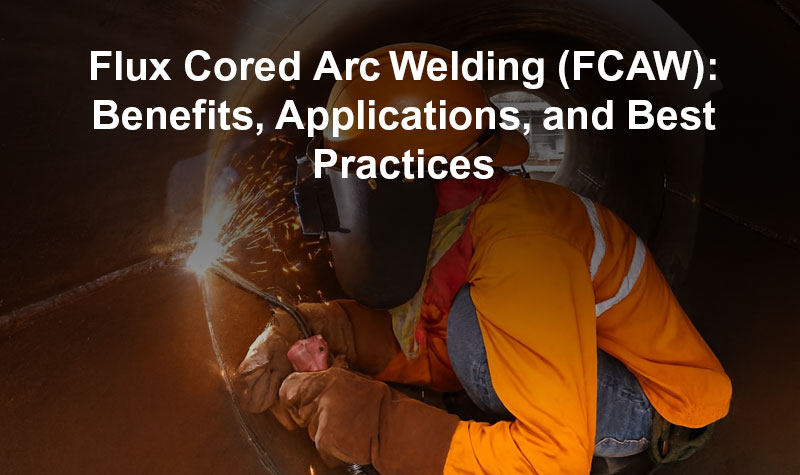
FCAW welding begins when the welder activates the welding gun. The wire feeder pushes the tubular flux-cored wire through the torch, while an electric arc forms between the wire and the base metal. This arc melts both materials, forming a molten weld pool. As the flux melts, it creates a protective shield that prevents atmospheric contamination. In gas shielded FCAW, the external gas further enhances this protection. Slag forms on the weld bead and must be removed between passes to ensure smooth and uniform weld layers. This process allows welding in flat, horizontal, vertical, and overhead positions and is highly effective for thick materials requiring high deposition rates.
Advantages of FCAW Welding
Here are the main benefits that make FCAW welding a preferred choice for heavy fabrication:
- High deposition rate FCAW delivers one of the fastest metal deposition rates, speeding up project completion.
- All-position welding capability Suitable for complex structures and challenging access points.
- Strong and durable welds Ideal for high-load and high-stress environments.
- Cost-effective for heavy fabrication Faster completion reduces overall labour and operational costs.
- Reliable in Indian outdoor environments Performs well even in dusty, windy, or humid conditions.
For structural applications, products such as Superon Flux Cored Welding Wire are commonly used to support consistent penetration and stable arc performance in demanding environments.
Common Applications of FCAW Welding in India
FCAW welding is widely used across multiple sectors due to its strength and adaptability:
- Construction Frameworks, bridges, beams, and steel structures
- Shipbuilding Large steel plates and structural joints
- Heavy equipment repair Excavators, cranes, bulldozers and agricultural machinery
- Manufacturing and fabrication Pressure vessels, tanks, trailers, and industrial units
- Infrastructure development Railways, metro construction, and government engineering projects
Best Practices for FCAW Welding
To achieve high-quality results, welders should follow these practices:
- Select the correct flux-cored wire for the base metal
- Use appropriate machine settings for voltage and wire feed speed.
- Maintain clean contact tips and smooth wire feeding.
- Remove slag after each pass.
- Ensure proper ventilation and safety measures.
- Store wires in dry conditions to prevent moisture absorption
- Ensure proper grounding and clean cables.
These steps help minimise defects and maintain consistent weld quality.
FCAW Welding vs Other Welding Techniques
| Welding Type | Deposition Rate | Portability | Weld Quality | Best Use Case |
| FCAW | Very high | High | Strong and reliable | Structural and heavy fabrication |
| MIG | High | Moderate | Very clean | Indoor fabrication |
| TIG | Low | Low | Highest precision | Thin metals and precision work |
| Stick Welding | Moderate | Very high | Good | Outdoor repairs and maintenance |
Why Choose Superon Technik for FCAW Solutions?
Superon Technik is a trusted supplier of welding consumables designed for industrial-grade performance. Its range of SUPERON Flux Cored Welding Wires supports stable arcs, strong joint formation, and consistent weld quality across varied working conditions. With wide availability across India and a strong focus on reliable fabrication solutions, Superon Technik supports sectors including construction, manufacturing and heavy engineering with products that deliver dependable performance where it matters most.