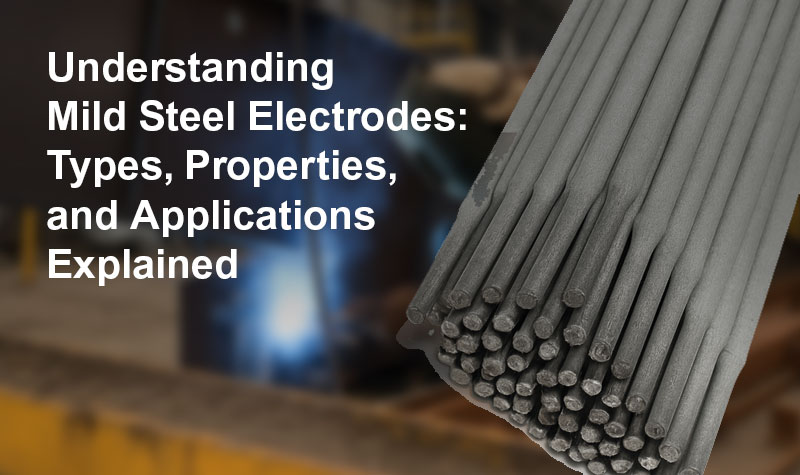
Mild steel electrodes are among the most widely used welding consumables in the world of fabrication and industrial manufacturing. They offer flexibility, dependable strength, and smooth welding performance, which makes them suitable for beginners as well as experienced welders.
Understanding MS welding rod, its types, and its numbering system helps you make the right choice for your project. With high-performance welding consumables, welders across India can achieve strong and reliable welds with ease.
What is an MS Welding Rod?
An MS welding rod is a consumable electrode used mainly in shielded metal arc welding. It is designed for welding mild steel or low-carbon steel materials. The rod consists of a steel core wire coated with a flux layer that stabilises the arc, cleans the weld pool, and forms a protective slag after the weld cools.
Because mild steel is widely used in construction, automotive repair, fabrication, and machinery manufacturing, MS welding rods remain an essential choice for consistent, durable, and cost-effective welding performance.
Types of MS Welding Rods
Different welding jobs require different types of electrodes. Each rod type has its own properties, arc behaviour, and usability. Understanding MS welding rod types helps welders select the right consumable for strength, penetration, and weld appearance.
Low Hydrogen Electrodes (E7018)
E7018 is known as a low-hydrogen MS welding rod. It offers:
- Excellent crack resistance
- Deep penetration
- Moisture resistance when stored properly
- Clean and smooth weld deposits
- High tensile strength
Ideal for:
- Structural fabrication
- Bridges
- Heavy machinery
- Critical load-bearing welds
- High-strength mild steel components
Cellulose Electrodes (E6010 and E6011)
E6010 and E6011 rods have a cellulose-based flux coating that provides strong penetration and a fast-freezing slag.
Key features:
- Deep penetration into dirty or rusty surfaces
- Strong arc force
- Excellent for root passes
- Good for outdoor and pipeline welding
Applications:
- Pipeline welding
- Shipbuilding
- Outdoor construction
- Industrial repair jobs
Rutile Electrodes (E6013)
E6013 is one of the most widely used MS welding rod types because of its simple usability and smooth arc performance.
Benefits:
- Soft and stable arc
- Easy slag removal
- Suitable for thin to medium thickness mild steel
- Clean weld beads with minimal splatter
Best for:
- General fabrication
- Sheet metal work
- Automotive repairs
- Home workshops
Quick Comparison Table
| Rod Type | Penetration | Slag Removal | Best Use Cases |
| E6013 | Medium | Easy | General fabrication and sheet metal |
| E6010 | Deep | Fast freezing | Pipelines, root passes |
| E6011 | Deep | Moderate | Outdoor, dirty surfaces |
| E7018 | Medium to deep | Easy | Structural welding and heavy-duty jobs |
Understanding MS Welding Rod Numbers
Ever wondered what those numbers on your welding rods actually mean? Each code gives you a snapshot of the rod’s capabilities. Let’s break it down. The “E” stands for electrode, followed by a set of numbers that tell you the rod’s tensile strength, the type of current it works best with, and the welding positions it can handle.
Here’s a quick reference table for some common MS rods:
| Rod Code | Tensile Strength | Current Type | Usable Positions | Notes |
| E6013 | 60 ksi | AC/DC | Flat, Horizontal | Smooth arc, easy slag removal |
| E7018 | 70 ksi | DC | All positions | Low-hydrogen, strong welds |
| E6011 | 60 ksi | AC/DC | All positions | Deep penetration, good for dirty metal |
Understanding these numbers helps you choose the right rod for your project and ensures your welds are strong, clean, and reliable.
Properties of Mild Steel Welding Rods
Mild steel welding rods aren’t just about melting metal; they’re engineered for performance. Here’s what makes them essential:
- Ductility: They bend and stretch without cracking, making them ideal for structures that face stress.
- Tensile Strength: Provides strong weld joints, crucial for heavy fabrication or construction.
- Weld Bead Quality: Smooth, uniform beads reduce the need for extra finishing.
- Slag Characteristics: Easy-to-remove slag keeps your work clean and efficient.
- Corrosion Behaviour: Offers reasonable resistance to rust, especially with proper finishing.
These traits make MS rods a reliable choice across repair work, industrial construction, and large-scale fabrication.
Applications of MS Welding Rods in Industrial Manufacturing
MS welding rods are used across multiple Indian industries where mild steel components are fabricated, repaired, or maintained.
1. Fabrication Workshops
Fabrication units use MS electrodes for welding railings, gates, frames, furniture structures, sheet metal assemblies, and general metal components. E6013 is commonly preferred because it provides a smooth bead appearance on materials used in most fabrication shops.
2. Automotive and Body Repair
Automotive workshops apply MS welding rods for repairing brackets, exhaust parts, chassis sections, mounting supports, and light structural components. E6013 is suitable for routine sheet metal repair tasks, while E6011 is chosen for surfaces that may have rust, dirt, or paint.
3. Construction and Infrastructure
Construction sites use MS electrodes for beams, staircases, reinforcement joints, on-site structural welding, temporary structures, and various mild steel fittings. E6011 performs well in outdoor settings such as building sites, where humidity, dust, and wind affect welding conditions.
4. Heavy Machinery and Equipment Maintenance
Maintenance teams for cranes, loaders, excavators, agricultural equipment, and factory machinery rely on MS welding rods for repairing worn parts and restoring structural components. E7018 is widely used because it delivers deeper penetration and strong welds needed for heavy equipment.
5. Industrial Plant Maintenance
Factories and industrial plants use MS electrodes for repairing damaged sections of conveyors, support frames, storage racks, ducting systems, and other steel structures. Industries such as engineering, steel processing, manufacturing, and textile production often use E6013 for routine maintenance and E7018 for components that require higher strength.
How to Choose the Right MS Welding Rod for Your Project?
Selecting the correct MS electrode depends on the material, welding position, equipment, and the strength required for the joint.
1. Base Metal Thickness
Material thickness influences electrode choice. Thin sheet metal is generally welded using E6013 because it offers a soft and controlled arc that prevents burn-through. Medium thickness and heavy sections require stronger penetration, so E7018 or E6011 perform better in these situations due to their deeper arc characteristics.
2. Welding Position
Different electrodes behave differently in vertical or overhead positions. E6011 and E6013 are suitable for these positions because they produce fast-freezing slag that supports the molten metal. In flat or horizontal welding, most MS electrodes work effectively, so selection can be based on preferred bead appearance or required penetration.
3. Welding Current Type
Machine compatibility is an important factor. E6013 and E6011 work on both AC and DC machines, which makes them practical for workshops with mixed equipment. E7018 is usually preferred with DC because it offers better arc stability, controlled penetration, and a consistent weld puddle.
4. Required Weld Strength
Strength expectations influence electrode selection. General fabrication tasks use E6013 because it provides a balanced bead appearance and moderate strength. Structural applications, heavy load-bearing joints, and critical components typically require the higher strength offered by E7018.
5. Working Environment
Indoor and outdoor conditions affect rod performance. Outdoor fabrication or repair work often involves wind, dust, or surface contamination. E6011 performs well in such situations because it maintains arc stability even on imperfect surfaces. Indoor fabrication can use a wider range of electrodes depending on finish and strength needs.
6. Penetration Needs and Machine Capability
Penetration depth must match the joint design. Thin materials require controlled penetration, while thicker joints need deeper fusion. Machine capability also matters. Smaller AC machines work well with E6013, while larger DC machines can support the deeper penetration and stability required for E7018.
Tips for Proper Storage and Handling of MS Welding Rods
Correct storage maintains electrode quality and prevents moisture-related issues.
- Keep electrodes in sealed packaging
- Store low-hydrogen rods in heated ovens
- Use dry and dust-free storage spaces
- Avoid placing electrodes directly on the floor
- Follow the first-in, first-out usage rotation